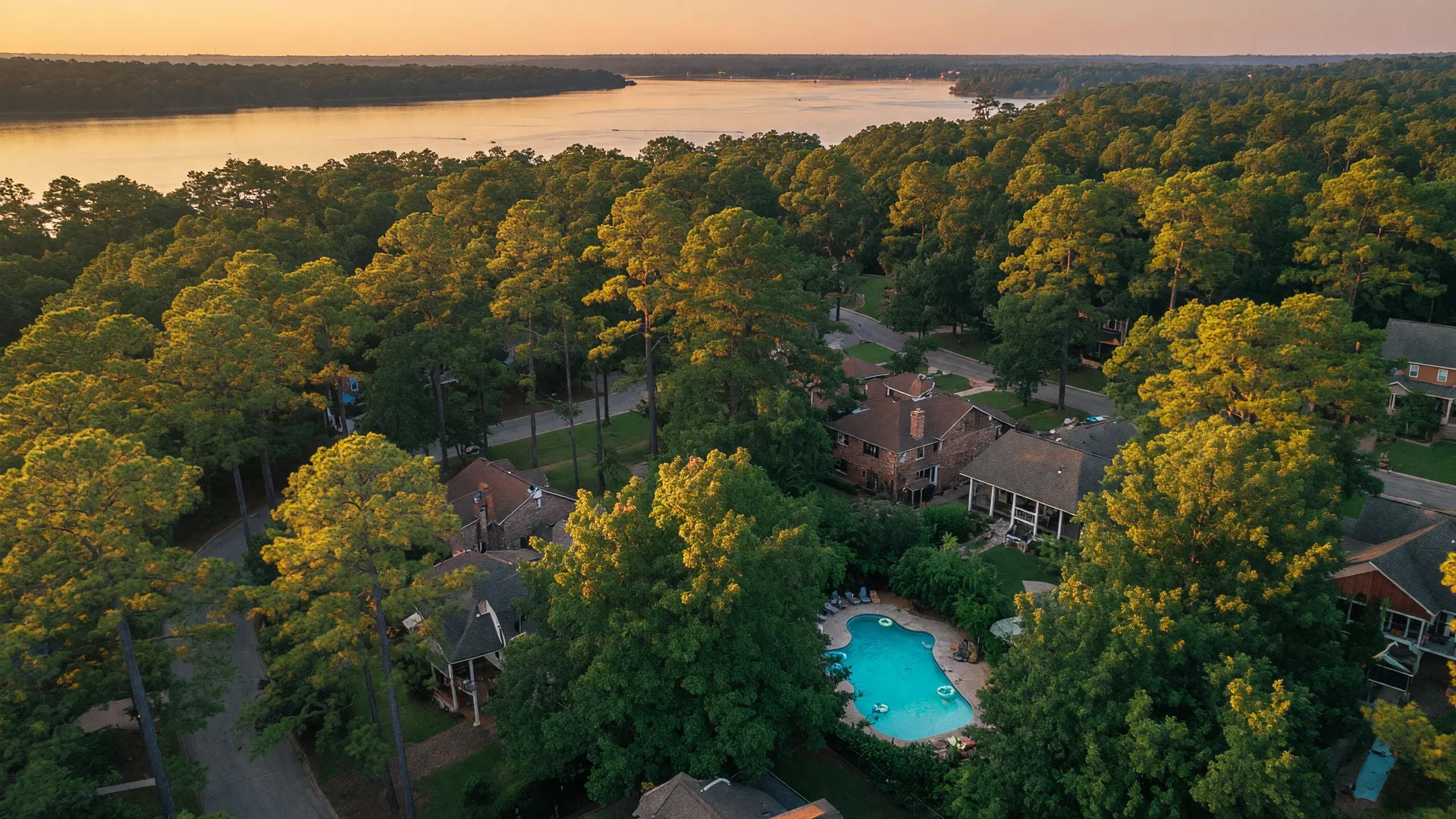
Living in Kingwood means living inside a deliberate experiment: a master-planned community drawn around the trees instead of through them. The history of Kingwood, Texas traces to a single land deal on December 28, 1967, when a joint venture of the King Ranch and the real-estate arm of Exxon bought roughly 14,000 forested acres along Lake Houston, and the first homes were completed in 1971. The community that grew from that deal, still called the Livable Forest, shapes what the streets, the homes, and the address at 4211 Brook Shadow Dr feel like today.
Before the homes: timberland along the San Jacinto
The ground Kingwood stands on was built for the forest long before it was built for houses. The City of Houston dammed the San Jacinto River just north of the site, completing the San Jacinto Dam in December 1953 and starting deliberate impoundment of Lake Houston on April 9, 1954. The lake, still owned by the city as its primary municipal water reservoir, gave the future community a 76-mile shoreline (by the usual reckoning) of water views, creeks, and low, flood-prone bottoms that would later become greenbelts rather than building lots.
The upland between those creeks was working timberland, low and sandy, covered in loblolly pines and oaks and held for decades by lumber companies, much of it by Foster Lumber Company. That is what the joint venture purchased in December 1967: pine-oak woodland, not farmland, and not an empty grid. How the buyer treated the trees would become the whole character of the place, because the buyer was two famous names in Texas history working together. Friendswood Development Company, the real-estate subsidiary of Humble Oil (later Exxon), and King Ranch, Inc. split the land, with Friendswood running the development. Construction began in 1970, and the first homes opened the next year.
Why is it called Kingwood?
The name is a compound of two partners: "King" from the King Ranch, whose 1967 land deal made the acreage available, and "wood" from the timberland itself. It is the rare Texas community whose name is also its pitch, because the plan refused to clear-cut. Builders were required to preserve mature pines and oaks on every lot, streets followed the land instead of a conventional grid, and the creek bottoms and low spots were drawn into a greenbelt trail system instead of being filled and sold. The marketing nickname that stuck, the Livable Forest, describes a real design rule rather than a slogan.
The rule matters because Harris County famously has no zoning, and Kingwood has no city hall either. The community is unincorporated, so the job of keeping the vision intact fell to associations instead: the Kingwood Service Association, a nonprofit chartered in 1976, and the village associations that sit under it. That arrangement is why the canopy survives, why streetscapes stay consistent, and why buyers can trust that the forest around a home is protected by rule, not by luck. Kingwood is often described as the largest master-planned community in Harris County, and a big part of that reputation is discipline, kept for more than five decades.
1971: the first homes and the village idea
The development started with a village, not a subdivision: Trailwood, whose first homes were completed in 1971, remains the community's oldest pocket. The planners' unit of neighborhood, the village, works the way the plot intended, with each village tucked into its own stretch of canopy, holding its own deed restrictions and entrances, and sharing the greenbelts that thread between them. As Kingwood grew through the 1970s and 1980s, the villages layered in: some along the lake, some along the golf courses, and some, like Greentree, filling the south end near the highway. The structure is easier to read on a map than to explain, so if you are comparing addresses, the buyer's guide to the villages walks through how the pieces fit together.
Greentree Village and the 1980s-1990s buildout
Greentree Village, where 4211 Brook Shadow Dr sits, developed mostly in the late 1980s and early 1990s, a newer, larger-feeling generation than the 1970s sections, with more than 1,700 homes and roomier traditional two-stories. The village's elementary school got there first: Greentree Elementary opened in 1981 under Humble ISD, before most of the surrounding houses went up, and the school helps explain how deliberately the village filled in around established anchors rather than the other way around.
The listing itself is a textbook Greentree-era home: built in 1991, with the two-story format the village was built around. Its front rooms give buyers options the plan itself valued, room for a dining table, a home office, a music room, or a quieter sitting area, and its school path runs straight down the village's own spine, Greentree to Creekwood to Kingwood High. The village park and pool, Brook Shadow Community Park at 3826 Brook Shadow Drive, sits on the same street as the house, which is the Kingwood plan working as designed: shared amenity, same canopy, no long drives.
The history you can see from 4211 Brook Shadow Dr
The most visible piece of Kingwood's history at this address is the backyard. The family room runs a full two-story wall of windows that looks straight out to the pool and heated spa, added in 2019, with a separate stretch of grass beyond the water for pets or play. That is the 1967 rule in daily form: the forest and the green yard stay part of the house, not something to visit. The long driveway leading back to the detached garage, the flexible front rooms, the trees framing the roofline, all of it reads as the village's original bargain, keep the trees, use the space well.
The community around it has grown up with the same logic. The wider Kingwood area today holds roughly 64,000 residents, per the City of Houston's 2020 planning profile for the Kingwood super neighborhood, on the same ~14,000 acres the 1967 deal set aside. Lake Houston still fronts the north and east edges, and the greenbelt system still carries the trails that the weekends in Kingwood post maps out, along the same creeks the planners chose not to build on.
Why the history matters to a buyer
For someone comparing addresses, the history is not decoration, it is due diligence. The mature canopy means lower afternoon temperatures on the street, more privacy between homes, and resale character you cannot plant quickly. The KSA and village rule structure means the streetscape you see on the tour is roughly the streetscape you will get. And the fact that the forest-first plan has held for more than five decades is the strongest signal yet that it will hold for the next buyer's tenure too. A home like 4211 Brook Shadow Dr benefits from all of it, and its 1991 vintage sits inside the mature half of the canopy, old enough for shade, young enough for modern systems.
The honest takeaway: Kingwood's history is a 1967 bet on trees and a disciplined plan, and it paid off as the Livable Forest. The address at 4211 Brook Shadow Dr, a 1991 Greentree home with a 2019 pool and spa behind a wall of windows, was built inside that bet. Diane can walk you through the neighborhood's history and the listing in the same visit, so you can see the forest and the house together before you decide.

Diane Hibbs
Strategic Real Estate Advisor · eXp Realty
Strategic real estate advisor, helping Northeast Houston buyers and sellers think through major housing decisions with clarity.