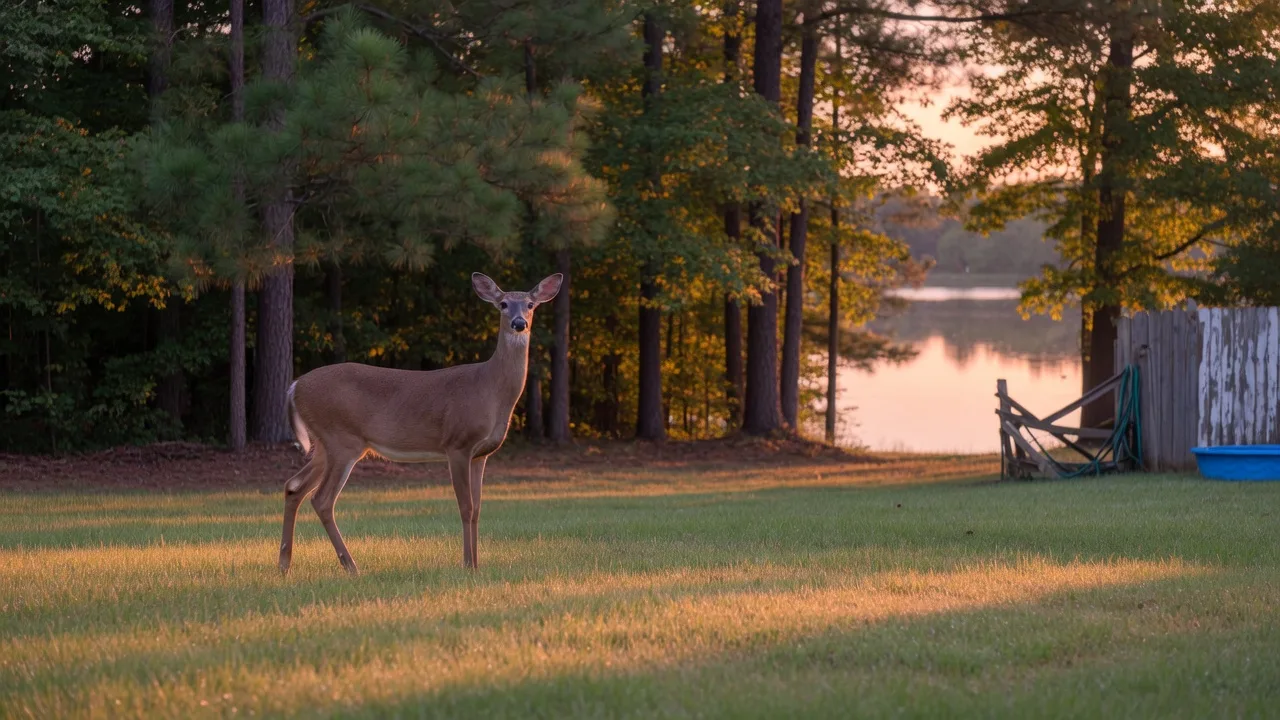
Kingwood has billed itself as "The Livable Forest" since the 1970s, and the wildlife is the reason the name works. White-tailed deer graze along the greenbelts at dusk, a bald eagle pair nests on Lake Houston, and more than 140 bird species have been documented at a single neighborhood preserve. For a buyer weighing a home like 4211 Brook Shadow Dr, sharing a neighborhood with that wildlife is not an occasional surprise. It is the baseline of daily life here.
What kind of wildlife actually lives in Kingwood?
Kingwood is a roughly 14,000-acre master-planned community built around the existing pine and hardwood canopy instead of scraping it away, so the forest and its residents never left. White-tailed deer are the headline act. Sightings are routine across the villages, with names like Deer Ridge and King's Forest reflecting the local population, and residents regularly spot deer crossing streets at dawn and dusk, browsing in side yards, and standing calmly along the trail edges. Texas holds an estimated 3.3 million-plus whitetails, and Texas Parks and Wildlife notes that suburban deer thrive wherever green space remains. Kingwood is exactly that: a forest with houses in it.
The rest of the regular cast:
- Squirrels, opossums, raccoons, and armadillos on the ground and in the trees.
- Herons, woodpeckers, and songbirds at every park pond and greenbelt creek.
- Coyotes, mostly heard at night more than seen, throughout the wooded villages.
- Turtles at the lakes, plus alligators in Lake Houston itself, best appreciated from a distance.
The sensible policy anywhere in Kingwood is to enjoy wildlife from a respectful distance, keep pets away from the water's edge, and never feed any of it.
The greenbelt is Kingwood's wildlife corridor
The Kingwood Service Association coordinates more than 500 acres of parks and preserves threaded together by more than 75 miles of greenbelt trails, and that network is what moves wildlife from the lake through the villages and back. Creekwood Nature Area and River Grove Park are smaller preserves tucked inside neighborhoods, while Deer Ridge Park offers the duck pond, ball fields, courts, and a nature trail for people. The trails double as habitat edges, which is why a slow walk at sunset reliably turns up deer.
From 4211 Brook Shadow Dr in Greentree Village, the system is minutes on foot, and the path stays under canopy the whole way: the same greenbelt trails covered in the weekend guide run right through this part of the forest.
East End Park: a Big Thicket remnant in the city
The preserve to know is East End Park at 6400 Kingwood Dr: 158.5 acres of woodlands, meadows, and wetlands on the Lake Houston shore, donated by Friendswood Development in 1994. The Kingwood Service Association describes it as "perhaps the richest remaining vestige of the Big Thicket bio-system in Harris County." It holds 3.5 miles of developed trails and boardwalks plus another 2 miles of natural trails, and members of the Lake Houston Nature Club and Houston Audubon have documented 141 bird species there: herons, woodpeckers, warblers, and migrants passing through on the Gulf flyway.
Bald eagles nest on Lake Houston
Kingwood is one of the few places in the greater Houston area where bald eagles are a local story, not a road trip. A nesting pair at The Clubs of Kingwood raised two eaglets in 2022, with chicks the year before, and residents report other active nests along the lake's western shore. The best viewing season runs through the cooler months, when eagles work open water near big trees; binoculars help, and the lakefront parks and greenbelt overlooks are the spots.
Will a Kingwood backyard really see deer?
From the family room at 4211 Brook Shadow Dr, the answer is often yes. The two-story window wall looks across the backyard to the 2019 pool and heated spa, past the separate stretch of grass kept for pets and play, and into the tree line beyond the fence. Deer routinely travel the timber lines that border Kingwood streets, and a dusk view of the yard is the classic first moment buyers remember here.
If you would rather keep deer out of the landscaping, the standard guidance from Texas Parks and Wildlife applies: do not feed them, choose plants deer tend to leave alone, and fence the plantings they will not. The same "look, don't feed" rule covers the rest of the wildlife around Lake Houston, and it keeps everyone, four-legged neighbors included, safer.
What wildlife means for buyers and sellers in Kingwood
For buyers, the forest is a feature with real structure behind it: the greenbelt system, the preserves, and the animal life are maintained and protected through the community's service association rather than left to chance. Homes that back to timber or sit a short walk from a trail, like this one, tend to hold their value precisely because the setting cannot be replicated. For sellers, the trees and the wildlife are part of the sales story, and the honest version of that story wins: this is a place to live with nature, not a zoo, and not a cleared lot either. Tour at dusk and you will see the difference.
The practical takeaway: living in Kingwood means choosing a home where the natural world is part of the everyday, from the greenbelt trail outside the door to the window wall that watches the backyard. See it for yourself in the photo gallery, then book a tour of 4211 Brook Shadow Dr and ask for a late-afternoon showing.

Diane Hibbs
Strategic Real Estate Advisor · eXp Realty
Strategic real estate advisor, helping Northeast Houston buyers and sellers think through major housing decisions with clarity.